Arghhh people !!! I fumbled the bag, I remember hearing about Bitcoin back in ’06 (it was 2011 really) and I should have grabbed a few coins while I had the chance. Now I’m sitting here scrambling for dogecoin and those other ones. I’m sure a lot of us have recently started investing, hoping that one of the newer coins take off, but what about the tech behind cryptocurrency? How is it so secure and why does it have the banks scrambling?
The tech behind cryptocurrency is called blockchain and it’s essentially a chain of blocks. I guess that wasn’t a good explanation, okay let me try again. Blockchain is a type of database that stores data in blocks and then chains them together. This concept was originally used to timestamp digital documents so it would be impossible to tamper with them. This method was then adapted by Satoshi Nakamoto to create what we now know as Bitcoin.
Each block in a blockchain contains three elements: a piece of data, a hash* value, and the previous block’s hash value. The data stored in a block depends on the type of blockchain. For example, let’s take the Ethereum blockchain, the data stored will be the details of the transaction, so we would see the sender’s details, recipients’ details, and the number of coins being transferred. Moving onto the hash, this is a mixture of numbers and letters which is used to identify a block (think of a hash as a fingerprint). They are useful for detecting changes, so if data changes inside the block, the hash will also change causing the block to be different. Lastly, a block contains the hash of the previous block thus creating a chain.
Fun Fact (Maybe its not that fun) : The first block inside of a blockchain is called a Genesis block.
Technical lah-di-da-di (Not for the faint hearted)
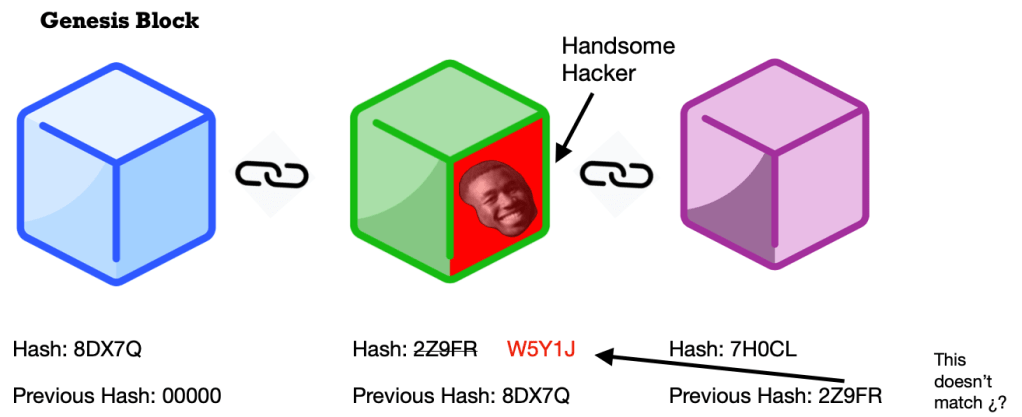
How is blockchain so secure? Well, if a block has been messed with, this will cause the hash of the block to change. In turn, this will make the next block invalid because it no longer has the hash of the previous block (see picture below). However, just hashes alone do not make blocks secure. Hackers can use supercomputers that can produce thousands of hashes per second so that they can tamper with a block and recalculate the hashes of the other blocks to make the chain valid again.
Mmmm not so fast though, blockchain also makes use of proof-of-work. This is a protocol used to slow down the creation of a new block by adding a maths equation that needs to be solved to figure out the nonce** for a block. This makes the blocks harder to tamper with because once you tamper with one block, you’ll need to figure out the proof-of-work for the other blocks. Also, this is a very expensive process and will take up way too much computer power. Additionally, blockchain uses a peer-to-peer network, so when someone creates a new block, it’s then sent to everyone on the network. Each node*** then verifies the block to make sure it hasn’t been tampered with. Consequently, If you wanted to fully hack into the blockchain, you’ll need to tamper with all the blocks on the chain, re-do the proof-of-work for each block and then take control of the majority of the peer-to-peer network. It’s mission impossible (we know how that story ends) but once this is done your tampered block will be accepted.
In saying all of that, I do think the potential uses for blockchain will benefit us in society and help protect our data. A few uses include: storing medical records; recording election votes and the creation of smart contracts. As for the banking industry, they should definitely feel threatened as we wouldn’t need them anymore. Blockchain is way more seamless because it trumps the processing times and facilitation of payments that these banks offer; meaning we can finally say goodbye to those pending transactions (if you don’t want to take my money just say that). I think blockchain is a great piece of innovation but should be regulated properly because us humans tend to do way too much, and then the drawbacks of blockchain will become ever more glaring. Anywho, we shall see what the future holds.
*it’s used to verify that data has not been tampered with, these values are also unique
**it’s a number added to a hashed block
*** it’s a device used to record a transaction
Love & Guidance
TT
 The TT Protocol
Blockchain’s really do seem like the future. Big benefit is that they can be public too
LikeLike
Ngl this was my fave!
LikeLike
You’re too kind 😭
LikeLike